

You don’t need to know any of this to use the service.
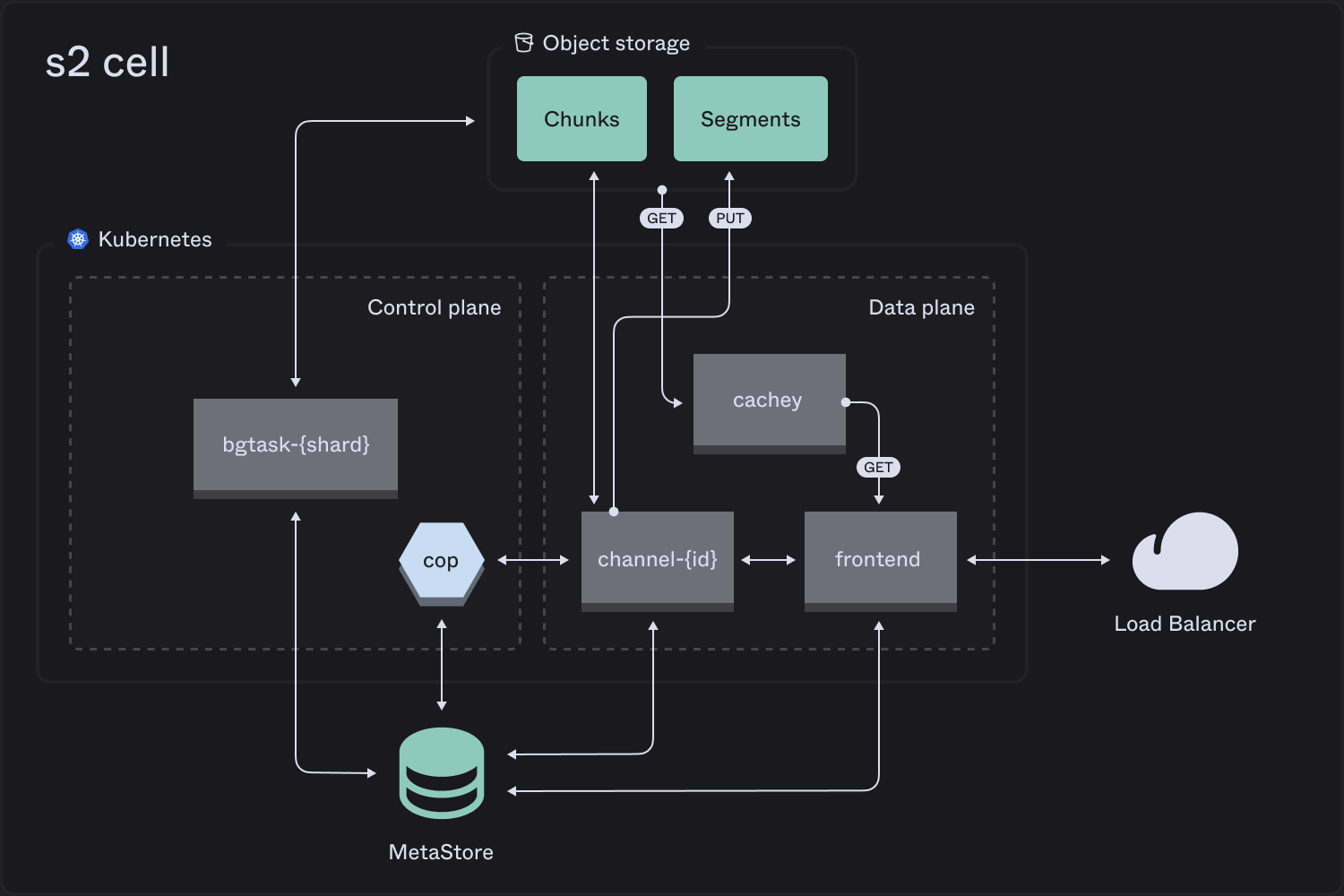
Control plane
cop(“channel operator”) ensures resilience and elasticity of stateful pieces:- supervises and creates/destroys channels
- rebalances load by migrating streams
bgtask(“background task”) workers partitioned on role and keyspace handle async jobs, such as garbage collection.
Data plane
frontendreplicas are an elastic deployment that fronts all API requests, acting as a gateway layer.cacheyreplicas form an elastic read-through cache per zone for all reads from object storage.channelpods sequence writes with a WAL maintained as sequential chunks, and flush batched stream segments accumulated over a longer timeframe.
Our read-through cache, cachey, is an open source project.
Write path
Thefrontend talks to the assigned channel for the stream to append records.
If necessary it will first activate the stream by assigning to a channel using power of 2 choices for load balancing.
Channels multiplex stream records in chunks on object storage (effectively a WAL), flushing based on a combination of elapsed time and accumulated size. Appends are only acknowledged when associated records are durable in a chunk.
Over a longer timeframe, channels batch records from the WAL into per-stream segments and update stream metadata to reference them. This keeps the write acknowledgement path short while giving the read path larger, stream-local object byte ranges to scan.
Once a stream is active, metadata storage is not in the hot-path of writes — only object storage.
Read path
Thefrontend uses stream metadata to generate a concatenated iteration over relevant stream segments. This is further chained with pointers into chunks (the channel WAL), if the client is reading recently-written data.
It fetches relevant object byte ranges via a cachey pod in its own zone, using rendezvous hashing with bounded load to optimize hit rate without hotspotting.
Concurrent reads are combined wherever possible:
- Tailing readers are coalesced on the
frontendas well aschannel cacheywill coalesce reads for the same “page” of an object
Stream lifecycle
Streams are made up of a chain of streamlets. There is usually only one, but multiple may exist when the stream is being migrated between channels, or migration(s) recently completed. Streamlets take up a tiny amount of memory on channels — and only stick around if there have been recent writes. Dormant streams live only as metadata and segment data.Storage classes
The choice of storage class affects latency of appending and reading recently-written records. In AWS,Standardis powered by channels operating against an S3 Standard chunk storage bucket, which guarantees writes are durable in multiple zones.Expressis powered by channels operating against a quorum of three S3 Express zonal chunk storage buckets — so writes are still guaranteed to be durable in multiple zones, but with much lower latency.
Quality of service
Admission control and load balancing logic is embedded into components in the online request path. Auto-scaling and stream migrations handle sustained shifts. To optimize throughput, the data plane employs pipelining, i.e. multiple in-flight operations with an ordering dependency. This is not just a server-side concern; S2 client SDKs will also pipeline when using the append and read session APIs. Stream migrations use a speculation-based protocol that keeps the write pipeline flowing to minimize disruption.Correctness
Beyond unit and integration tests, we practice deterministic simulation testing. S2 involves many moving parts, and investing in DST allows us to test the invariants the system must always uphold. Deterministic testing lets us run the processes that comprise S2 over a simulated network. We can inject faults, crash processes randomly, trigger recovery procedures, and check that we do not violate our commitments to durability and strong consistency. Our setup includes a custom Rust framework built with Turmoil, which we run in CI/CD and in larger nightly searches for subtle regressions. We also use Antithesis as a second form of DST, and verify linearizability with the Porcupine model checker.Local
s2-lite
The open source implementation of S2 has a distinct architecture optimized for ease of deployment as a single binary. See how it compares with the cloud service.